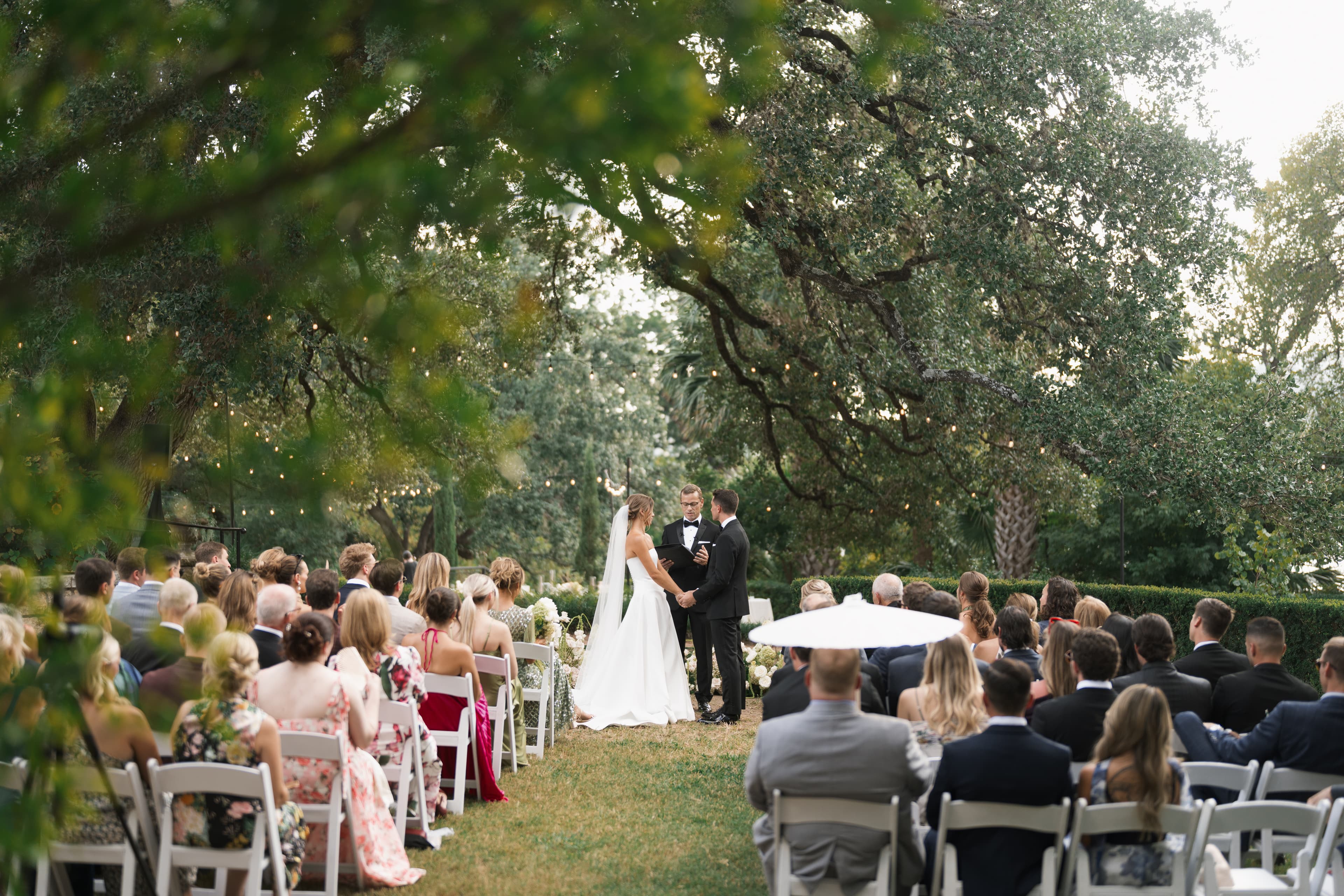
Choosing among Charleston wedding venues is less about collecting pretty photos and more about finding a place that can actually hold your day. The Lowcountry gives you oaks, marsh light, historic gardens, and downtown rooms with real character. Each of those settings asks something different of the timeline, the weather plan, and the guest experience.
We plan weddings in Charleston and the South Carolina Lowcountry, and a good share of our couples book from out of state, so they need an honest read on a property before they ever fly in. This is that read, not a photo roundup. The five venues below are the ones we keep coming back to because they photograph beautifully and because they can carry a whole wedding weekend when the details get sorted early.
How we evaluate a Charleston wedding venue
Before you fall in love with an aisle of oaks, run the property through a practical filter. The prettiest Charleston wedding still feels stressful if guests cannot park, the ceremony has no rain plan, or the catering kitchen cannot handle the dinner you have in mind.
- Guest count and circulation. A venue that feels roomy at 80 guests can feel tight at 180. Ask where people gather after the ceremony, how the kitchen plates dinner, and whether the dance floor still leaves a path for service.
- Rain, heat, and wind. Lowcountry weather is part of the design. Confirm a true indoor backup, how quickly it can be flipped, and whether summer heat or marsh wind will change your ceremony time.
- Guest access. Downtown hotels, West Ashley, and Mount Pleasant are not interchangeable for shuttles. Map the drive, the bridge delays on a Saturday evening, and where out-of-town guests will end up staying.
- Vendor rules and preferred lists. Some properties are flexible. Others require in-house catering, a short list of rental partners, or a hard stop for quiet hours. Those rules shape your budget and the creative team you get to hire.
- Total cost, beyond the rental fee. Ceremony sites, tenting, generators, lighting, restrooms, overtime, and required vendors can move the number as much as the venue itself. Build the full picture before you book.
- Event flow. Walk a whole wedding through the property in your head. Welcome hour, ceremony, portraits, dinner, dancing, sendoff. If the layout leaves guests waiting in the sun, or sends the two of you away for forty-five minutes, the night will feel it.
If you are still comparing properties, it is worth walking them with someone who has already run a wedding there. That is often the difference between full-service planning and trying to piece the day together from a brochure.
Magnolia Plantation
Magnolia Plantation is the garden-forward Charleston wedding many couples picture before they ever visit. Camellias, wide lawns, and the Ashley River as a quiet backdrop. It suits celebrations that want a romantic, landscape-led feeling rather than a ballroom-first night.
The ceremony lawns feel discovered rather than staged, and you are never short on places to shoot portraits. Even in peak season it still reads as Lowcountry. We start the downtown transportation plan early, build a rain and heat strategy that keeps people out of open sun, and hold a timeline that protects portraits without pushing dinner late.
Magnolia is a strong match for couples who care about gardens, golden hour, and a softer storybook mood. It is the wrong pick if you want everything under one air-conditioned roof, or if your guest list needs a compact footprint. You can see how a garden celebration can feel in our portfolio, including stories set among Charleston oaks and planted grounds.
Boone Hall
Boone Hall is the most recognizable of the Charleston wedding venues on this list. The Avenue of Oaks does most of the work before you style a single thing. Mount Pleasant is an easy drive for local guests, and the property is big enough to hold a wedding that is historic and festive at the same time.
The planning work here is scale and sequence. Anyone can picture the photographs. A calm guest experience takes more intention than that. We look hard at ceremony placement, where cocktail hour lives so it does not bottleneck, and whether the reception space can support dinner service at your guest count. Summer heat and Saturday traffic over the Ravenel Bridge belong in the conversation at the first site visit, not in June.
Choose Boone Hall if the oaks are part of your story and you want a plantation setting with room to host a full celebration. Reconsider, or at least tent and shuttle with extra care, if your group is small and you want a quieter, house-party feeling. Boone Hall rewards a team that has already thought through vendor load-in, guest arrival, and the moment after “I do,” when everyone needs a drink and a place to land.
Lowndes Grove
Lowndes Grove sits on the Ashley River in Wagener Terrace, ten minutes from the King Street hotels, with the kind of water-and-white-house composition couples send us before the first call. River views, a wraparound piazza, and real indoor rooms make it one of the more flexible waterfront options on the peninsula.
We like Lowndes Grove when a couple wants sunset on the water without giving up a real indoor plan. The house covers you for portraits and for weather. The grounds hand you that Lowcountry horizon. The work is in the flow between ceremony, cocktail hour, and dinner so nobody makes the same long walk twice, and in timing portraits around the tide, the sun angle, and the light inside the house.
This venue is a natural fit for couples who want a waterfront wedding that still feels residential and polished. It gets harder if your design needs a blank industrial box, or if a long guest list pushes the whole party under a tent on the grand lawn and that is not the picture in your head. When it is done well, Lowndes Grove feels like a house party that grew into a wedding. Still intimate. Still elevated.
The Cedar Room
The Cedar Room, inside the Cigar Factory, is the downtown counterpoint to the plantation lawns. Brick, timber, and a true indoor volume make it one of the strongest rain-plan and summer-heat answers among Charleston wedding venues, especially for couples who want an urban weekend.
Guests can stay within walking distance, an Uber at midnight is realistic, and the room takes a more modern floral and lighting plan than a historic garden will allow. The planning questions change too. Instead of tents and bugs, you are talking about sound, ceiling treatments, candle rules, and how to carve ceremony, dinner, and dancing out of one handsome room without the night feeling like a reset.
Choose The Cedar Room if you want downtown energy, a reliable indoor celebration, and design that can go a little more fashion-forward. If your heart is set on an outdoor aisle under live oaks, this is probably your welcome-party or rain-backup conversation, not your first-choice ceremony. For winter weddings and destination guests flying into CHS, the logistics are often simpler here than on a rural property.
Middleton Place
Middleton Place is Charleston at its most formal and historic. Terraced gardens, river views, and a sense of occasion that does not need much styling to feel important. Couples who want an editorial, classic Lowcountry wedding often land here after they have already fallen in love with the gardens.
The property is big, which is both the gift and the work. Distances between ceremony, portraits, and dinner will stretch a timeline if you do not protect it. Humidity is real, a clear rain plan is not optional, and the design should sit with the gardens rather than compete with them. Middleton Place is not a blank canvas. It is a historic landscape you get to borrow for a day.
It is a beautiful match for black-tie or garden-formal celebrations, especially when your guest list will enjoy a more ceremonial pace. It will fight you if you want casual, late-night party energy, or if your design depends on transforming the architecture. If Middleton is on your shortlist, walk it with your planner and photographer before you book. The photographs you want and the walking you are asking of grandparents should agree with each other.
Quick comparison by couple priority
No two Charleston wedding venues solve the same problem. Use this as a starting filter, then confirm with a visit and a real budget.
- Garden and landscape first. Magnolia Plantation or Middleton Place.
- Iconic oaks and a classic plantation frame. Boone Hall.
- A waterfront house with indoor backup. Lowndes Grove.
- Downtown, indoor, and summer-proof. The Cedar Room.
- Destination guests and hotel access. Lean downtown, or plan shuttles as a non-negotiable line item rather than an afterthought.
When to use full-service vs partial planning
Venue selection is usually where couples decide they want a planning partner. Picking a pretty place is the easy part. Then the contract, the rain plan, the preferred vendor list, and the guest logistics all land in the same week.
Choose full-service planning if you are starting from the beginning, planning from out of town, or you want one team to hold venue, vendors, design, and wedding-weekend execution together. That is the right path when you want a Charleston wedding planner in every vendor meeting, not just on the day.
Partial planning is a better fit if the venue is already booked and the guest list is taking shape, but you still need help tightening design, filling vendor gaps, and building a production timeline that will actually run. You keep the progress you have made; we bring structure before the final months get noisy.
If you already have most of your vendors and mainly need someone to run rehearsal and wedding-day logistics, wedding-day management may be enough. Either way, the earlier you bring a planner onto a historic or outdoor Lowcountry property, the fewer expensive surprises you inherit from a contract you signed too fast.
Build the rest of the team
A venue is only as good as the people working inside it. Catering, florals, photography, and rentals decide how Boone Hall or The Cedar Room feels at 8 p.m. Start with our Lowcountry vendor list for a sense of the teams we trust, then let the property’s rules and your design direction narrow the field.
A preferred-vendor list is not automatically a red flag, but it is information. Some lists protect quality and load-in. Others quietly raise your budget. We read them the way we read a floor plan, as a constraint to plan around rather than fine print you discover in May.
Planning from out of town
Many of our couples are not in Charleston full time. If that is you, please do not venue-hunt through Instagram alone. Shortlist two or three properties that fit your guest count and your weather plan, then come in for one focused visit. Or send us first. We can walk the rooms, ask the unglamorous questions, and tell you whether the photos match the guest experience.
Destination weekends also need a hotel block, a shuttle plan, and a welcome event that does not exhaust everyone before Saturday. The venue you choose quietly decides all three. Downtown indoor venues make guest access simple. Plantation and garden properties are usually the memory people flew in for, as long as the transportation is designed instead of improvised.
Let’s walk it together
If you are early in the search, we would rather help you choose well than help you recover from a venue that cannot hold your day. Book a consultation and bring your guest count, season, and the two or three images you cannot stop thinking about. We will tell you which Charleston wedding venues can actually deliver that feeling, and which ones only photograph that way.